GST Registration & Composition Scheme
Obtain Your GSTIN • Understand Mandatory Requirements • Simplify Tax with Composition
GST Identification Number (GSTIN)
GSTIN Structure
GSTIN is a unique 15-digit tax identification number assigned to every registered entity (Company, LLP, Individual, etc.).
- First 2 digits: State Code.
- Next 10 digits: PAN Number of the entity/person.
- Next 1 digit: Entity/Registration count within the state.
- Last 2 digits: Random alpha-numeric checksum numbers.
Mandatory Turnover Threshold
Registration under GST is generally mandatory if the total annual aggregate turnover crosses the prescribed limit:
- Standard States: Crossing the Threshold Limit (Rs 40 lacs or Rs 20 lacs).
- North Eastern States (Special Category): Turnover exceeds Rs 20 lacs.
Cases Where GST Registration is Mandatory
- Export Sales or services.
- Interstate Sales or supply of goods/services.
- Selling goods/services on E-commerce sites.
- Tax liability under Reverse Charge Mechanism (RCM).
- Casual Taxable Person or Non-Resident Taxable Person.
- Input Service Distributor (ISD).
- Crossing the threshold limit.
Key Benefits of GST Registration
- GST registration enables entrepreneurs to start a new business and open a current bank account.
- It helps maintain better accounting and financial management for firms and companies.
- GST allows businesses to carry out both B2B and B2C sales and purchases smoothly.
- The GST registration process is simple and quick, especially for proprietorship firms.
- It results in lower tax liability for eligible taxpayers.
- GST imposes fewer compliances, making it easier to manage.
- It allows interstate sales without restrictions.
- GST enables interstate supply without any barriers.
- Registration makes it easier to list and sell products on e-commerce platforms.
- Businesses gain a competitive advantage by being GST-compliant.
- GST offers a higher threshold limit for registration.
- It provides access to the Composition Scheme, reducing tax and compliance burden.
- The GST process is simple, fully online, and easy to complete.
- Overall, GST involves fewer compliance requirements, making it business-friendly.
Documents Required for GST Registration
- PAN Card and Aadhaar Card (with registered mobile number).
- Photo scan copy.
- Trade License & Professional Tax Registration (if applicable).
- Letter of Authorization for Signatory.
- Digital Signature (Class-3) in case of Companies.
- Business Premise Proof (Rented): Electricity bill (not older than 3 months) with Rental Agreement.
- Business Premise Proof (Owned): Mutation certificate/Land porcha with tax receipt (for few states).
- NOC from Premises Owner/Landlord.
- Company/LLP: PAN, MOA, AOA.
- Partnership: PAN and Deed.
Physical Verification for GST Registration
As per provisions of rule 9 of the Central Goods and Services Tax Rules, 2017, physical verification of the business premises of the applicant is mandatory under any of the following circumstances:
- The applicant has not opted for Aadhaar authentication.
- The applicant has opted for Aadhaar authentication, but the process has failed.
In many states, it has recently become mandatory for police and GST Officers to verify premises before a new GSTIN is allotted. Registration is granted only after successful physical verification in the above scenarios.
Based on the above provisions, it can be concluded that under any of the above circumstance, the GST registration will be granted post completion of physical verification by the proper office.
The GST Composition Scheme
Who Can Opt for the Scheme ?
- SMEs seeking lower compliance and simplified tax assessment.
- GST registered taxpayer whose aggregate turnover is below ₹1.5 crore. (Limit is ₹75 lakh for Special Category States.)
- The Aggregate Turnover of all organizations under the same PAN is used for calculation.
- Sellers of intra-state supply of goods.
- Service provider of only the restaurant sector (not serving alcohol).
- Taxpayer who is subject to RCM but pays tax at typical rates under the RCM mechanism.
Businesses NOT Eligible
- Service providers (except restaurant services).
- Inter-state sellers (supply of goods or services).
- E-commerce sellers (who collect tax at source).
- Supplier of non-taxable goods.
- Manufacturer of Notified Goods (e.g., specific tobacco products).
- Suppliers of ice cream, pan masala, or tobacco (and its substitutes).
- Casual Taxable Person.
- Non-resident Taxable Person.
- Supplier of exempted goods or services.
Scheme Rules & Limitations
Composition dealers pay nominal tax rates depending on the business type (e.g., 2% for manufacturers, 5% for restaurants, and 1% for other suppliers). A major simplification is that they are required to file only one quarterly return (GSTR-4) instead of monthly returns filed by regular taxpayers. A critical limitation is that Composition dealers cannot issue tax invoices, meaning they are prohibited from collecting tax from their customers and must pay the tax liability themselves. Furthermore, taxpayers opting for the Composition Scheme are strictly restricted from claiming any Input Tax Credit (ITC) on their purchases.
Major Penalties Under the GST Act
| Violation | Penalty |
|---|---|
| Not having GST Registration | 100% tax Due or Rs 10,000. Whichever is higher. |
| Not giving GST invoice | 100% tax due or Rs 10,000. Whichever is higher. |
| Incorrect Invoicing | Rs 25,000. |
| Not filing GST Tax Returns | For Nil Return its Rs 20 Per Day, Regular Returns Rs 50 Per Day. |
| Choosing Composition Scheme even if not eligible | 100% tax due or Rs10,000. Whichever is higher. |
| Not displaying Name board with GSTIN in place of business premises | Rs 25,000. |
| Apart from above there are several other penalties for GST |
Choose Your Plan
Professional solutions tailored for Gst Registration
Basic Plan
No Hidden Charges. Prices are inclusive of GST
- Gst Registration.
- Charges are inclusive of Gst.
Standard Plan
No Hidden Charges. Prices are inclusive of GST
- Gst Registration.
- Return filing for 6 months for B2B and B2C invoices.
- Book-Keeping and Accounting are not part of this package.
Premium Plan
No Hidden Charges. Prices are inclusive of GST
- Gst Registration.
- Return filing for 12 months for B2B and B2C invoices.
- Book-Keeping and Accounting are not part of this package.
- Charges are inclusive of Gst.
FAQ's on GST Registration
Your Questions Answered
Who is compulsorily required to get GST Registration?
Any person whose aggregate annual turnover exceeds the specified threshold (currently Rs 40 Lakh for goods and Rs 20 Lakh for services, with lower limits for Special Category States) must register.
Is GST Registration mandatory even if the turnover limit is not crossed?
Yes, GST registration is mandatory for certain cases regardless of turnover, such as making interstate supplies, e-commerce operators, and casual taxable persons.
What are the different types of GST registration that can be applied for?
The main types include Normal Taxpayer, Casual Taxable Person, Non-Resident Taxable Person, and Composition Scheme Taxpayer.
What is the benefit of registering under the GST Composition Scheme?
The Composition Scheme is a simple scheme for small taxpayers that allows them to pay GST at a fixed percentage of turnover, thereby simplifying compliance with fewer returns.
What is the time limit for applying for GST Registration?
An application for GST registration must be filed within 30 days from the date on which the person becomes liable to register.
What are the primary documents required for GST registration for a company/LLP?
Required documents typically include PAN Card, Aadhaar Card, proof of business registration (e.g., Incorporation Certificate), proof of address of the principal place of business, and bank account details.
What is the unique number assigned upon successful GST registration?
A unique 15-digit Goods and Services Tax Identification Number (GSTIN) is assigned to the taxpayer.
Can a business voluntarily opt for GST registration even if not liable?
Yes, any person or business can voluntarily register under GST, which allows them to collect tax and claim Input Tax Credit (ITC).
GST
Easily register your business under GST to start legal operations and tax compliance.

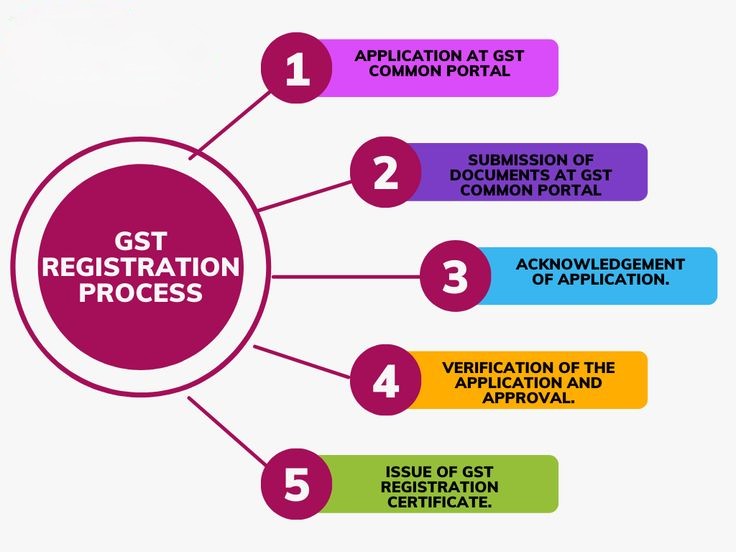
GST Registration Process
Get your business GST-ready by registering to comply with tax regulations.