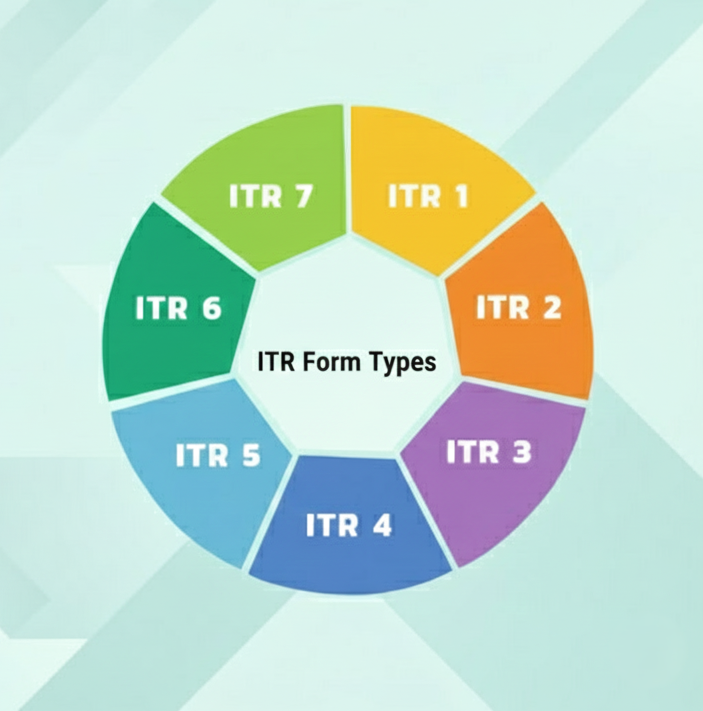
Income Tax Return - Form ITR-7
For Trusts, Non-Profit Organizations, Institutions, and Political Parties
Statutory Applicability (Under Section 139)
ITR-7 is specifically designed for individuals and companies whose income is required to be furnished under the following sub-sections of the Income Tax Act:
These sections cover mandatory filing requirements for Trusts, Political Parties, and certain institutions.
Eligibility: Who Must File ITR-7
Entities Covered by ITR-7
- All individuals who obtain income from property if said property is in the name of a Trust.
- All individuals who receive income for the sole purpose of charity or a Religious offering.
- Any political party that earns a net income that is more than the ceiling limit that is exempt from Income tax.
- Associations that carry out scientific research.
- News organizations and companies.
- Organizations as mentioned in Section 10(23A) and Section 10(23B).
- Educational institutions such as school, colleges or universities.
- Medical institutions such as hospitals, clinics etc.
Choose Your Plan
Professional solutions tailored for Income Tax Return 7
Basic Plan
Prices are inclusive of GST
- Income tax return filing for all companies other than those claming exemption having taxable income less than Rs 5 lakhs.
Standard Plan
Prices are inclusive of GST
- Income tax return filing for all companies other than those claming exemption having taxable income upto Rs 10 lakhs.
Premium Plan
Prices are inclusive of GST
- Income tax return filing for all companies other than those claming exemption having taxable income more than Rs 10 lakhs.
FAQ's on Income Tax Return - ITR 7
Your Questions Answered
Who is eligible to file ITR-7?
ITR-7 must be filed by persons, including companies, who are required to furnish a return under sections 139(4A) (Charitable/Religious Trusts), 139(4B) (Political Parties), 139(4C) (Scientific Research Associations, News Agencies, Institutions), or 139(4D) (Colleges, Universities).
Is ITR-7 mandatory even if the Trust's income is fully exempt?
Yes. An entity must file ITR-7 if its total income (computed without giving effect to the provisions for exemption under Sections 11 and 12) exceeds the maximum amount not chargeable to tax (the basic exemption limit for individuals).
What must be reported regarding income application for a Trust?
Trusts and institutions must disclose the income applied for charitable or religious purposes during the year. They are generally required to apply 85% of their income annually to maintain their tax-exempt status.
What is the consequence of not filing ITR-7 on time?
The primary consequence for trusts and institutions is the potential loss of their tax-exempt status for that financial year. If the return is not filed by the due date, the accumulated income and other benefits under Sections 11 and 12 can be denied.
Is an Audit Report mandatory with ITR-7?
Yes, if the total income of the trust or institution (before claiming exemption under Sections 11 and 12) exceeds the maximum amount not chargeable to tax (₹2.5 lakh), their accounts must be compulsorily audited. The audit report must be filed electronically.
What is the general due date for filing ITR-7?
The due date for filing ITR-7 is generally October 31st of the subsequent financial year, as most entities required to file ITR-7 are also subject to mandatory audit requirements.
Does ITR-7 require details of Donations Received?
Yes. ITR-7 has specific schedules (Schedule-VC) to report details of all voluntary contributions received. It also requires details of anonymous donations, which may be taxed at a special rate under Section 115BBC if they exceed specified limits.
How is ITR-7 filed and verified?
ITR-7 must be filed electronically on the Income Tax Department's portal. It is verified using a Digital Signature Certificate (DSC) (mandatory for Political Parties) or via Electronic Verification Code (EVC) for other entities.