Trademark Registration & Protection
Securing Your Intellectual Property for Products and Services
Trademark Registration
A trademark is a type of intellectual property consisting of recognizable sign, design ,or expression which identifies products or services of a particular source from those of others, although trademarks used to identify services are usually called service marks. The trademark owner can be an individual, business organization, or any legal entity. A trademark may be located on a package, a label, a voucher, or on the product itself. For the sake of corporate identity, trademarks are often displayed on company buildings. It is legally recognized as a type of intellectual property.
Exclusive Rights and Benefits of Registration
Legal Recognition and Protection:
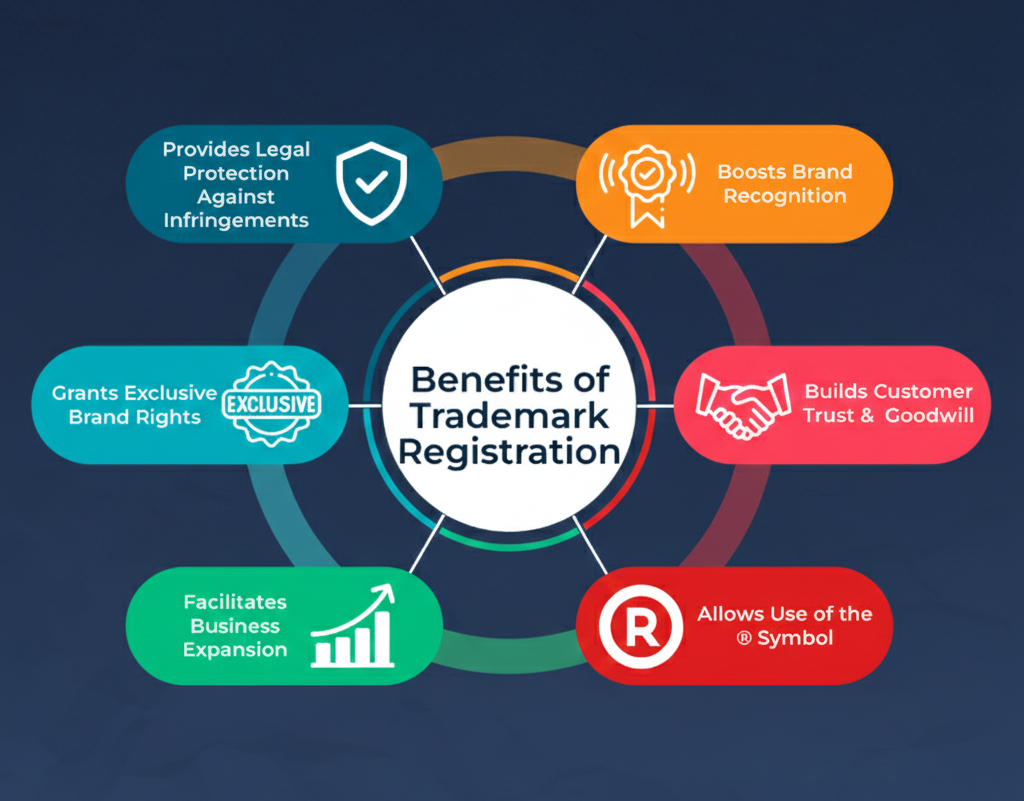
- Exclusive Right: Registration confers upon the owner the exclusive right to use the trademark for the registered goods/services.
- Statutory Symbol: Allows the owner to use the symbol (R) to indicate registration.
- Legal Relief: Enables the owner to seek relief for infringement in appropriate courts.
- Fee Rebate: Partnership firms or body corporates registered under the MSME or Start-up India schemes can avail a 50% rebate on the Government filing fee.
Documents Required for TM Registration
Essential Documentation Checklist:
- PAN Card and Aadhaar Card of the Signatory.
- Signed Form-48
- Digital Signature (Class 3).
- Copy of Logo (if applicable, optional for wordmark).
- Udyog Aadhaar Registration Certificate (for rebate).
- Proof of Entity: Incorporation Certificate or Partnership Deed.
- Company Documents: PAN, Memorandum of Association (MOA), Articles of Association (AOA) (in the case of a Company).
- Date of First Use: Details/Affidavit for date of first use (if applicable) or state "Proposed to be Used."
Classes of Trademark
Trademarks are categorized based on the goods (Classes 1-34) or services (Classes 35-45) they represent. Registration is specific to the chosen class(es).
| 1 | Chemicals | 23 | Yarns and Threads |
| 2 | Paints | 24 | Fabrics |
| 3 | Cosmetics and Cleaning Preparations | 25 | Clothing |
| 4 | Lubricants and Fuels | 26 | Fancy Goods |
| 5 | Pharmaceuticals | 27 | Floor Coverings |
| 6 | Metal Goods | 28 | Toys and Sporting Goods |
| 7 | Machinery | 29 | Meats and Processed Foods |
| 8 | Hand Tools | 30 | Staple Foods |
| 9 | Electrical and Scientific Apparatus | 31 | Natural Agricultural Products |
| 10 | Medical Apparatus | 32 | Light Beverages |
| 11 | Environmental Control Apparatus | 33 | Wines and Spirits |
| 12 | Vehicles | 34 | Smokers’ Articles |
| 13 | Firearms | 35 | Advertising and Business |
| 14 | Jewelry | 36 | Insurance and Financial |
| 15 | Musical Instruments | 37 | Building, Construction and Repair |
| 16 | Paper Goods and Printed Matter | 38 | Telecommunication |
| 17 | Rubber Goods | 39 | Transportation and Storage |
| 18 | Leather Goods | 40 | Treatment of Materials |
| 19 | Non-metallic Building Materials | 41 | Education and Entertainment |
| 20 | Furniture and Articles Not Otherwise Classified | 42 | Computer, Scientific and Legal |
| 21 | Housewares and Glass | 43 | Hotels and Restaurants |
| 22 | Cordage and Fibers | 44 | Medical, Beauty, and Agricultural |
Benefits of Trademark Registration
Trademark registration grants the owner an exclusive legal right to use the registered trademark in relation to the goods or services for which it is registered. The owner is entitled to use the ® symbol and can initiate legal action in appropriate courts in India in case of infringement, thereby safeguarding brand identity and goodwill.
These exclusive rights are subject to any conditions recorded in the trademark register, such as restrictions on the geographical area of use. In cases where two or more parties have registered identical or deceptively similar trademarks due to special circumstances, the exclusive rights may not operate against one another.
Date of First Use of Trademark
At the time of filing a trademark application, the applicant must specify the date of first use of the trademark in India, if the mark has already been used. Alternatively, the application can be filed on a “proposed to be used” basis where the trademark has not yet been commercially used.
If prior use of the trademark is claimed, an affidavit confirming such use must be submitted along with supporting documents such as sales invoices, advertisements, or letterheads bearing the trademark. The term “use” in India has a broad interpretation and includes advertisements in foreign journals circulated in India or use of the mark on commercial documents.
Priority Document Requirement
Where a trademark application claims priority from an earlier application filed in another country, a certified copy of the priority document or its duly notarized copy must be submitted to the Trade Marks Office within two months from the date of filing the application in India.
If the priority document is not in the English language, a notarized English translation is also required to be submitted to ensure proper examination by the trademark authorities.
Power of Attorney Requirement
For filing a trademark application through an authorized agent or attorney, a Power of Attorney is required. This document must be signed by the authorized signatory of the applicant, clearly mentioning the name and designation.
No notarization or legalization is required for the Power of Attorney, making the trademark filing process simple and hassle-free for applicants.
Government Fee Rebate under MSME & Start-up India
Partnership firms and body corporates registered under the MSME or Start-up India schemes are eligible for a 50% rebate on government trademark filing fees.
By submitting a valid MSME or Start-up India registration certificate, eligible applicants can significantly reduce the cost of trademark registration while enjoying full legal protection for their brand.
Key Trademark Forms
Filing Forms for Different Purposes:
- TM-A: Application For Registration Of a Trade Mark.
- TM-M: Application/Request for miscellaneous functions in respect of a trademark Application/ Opposition/Rectification under the Trade Marks Act.
- TM-C: For search and issue of certificate under rule 22(1). &Request for an expedited search and issuance of certificate under rule 22(3).
- TM-O: Notice of Opposition/Application for Rectification of the Register by cancelling or varying registration of a trade mark/Counter statement/Request to refuse or invalidate a trade mark u/s 25(a) (b) of GI Act, 1999.
- TM-R: Serch of Trade Mark Number.
- TM-P: Misc Application Like ADD OR ALTER TRADE MARK.
- TM-U: Request form.
- TM-G: Application for Registration of Trade Mark Agent.
Choose Your Plan
Professional solutions tailored for Trademark Registration
Basic Plan
Prices are inclusive of GST
- Trademark filing under one class for proprietorship and small enterprises
- Inclusive of Government fee and taxes (including Govt fees of ₹4,500)
- Digital signature charges are not included in the package
- Logo designing by professional graphic designers
Standard Plan
Prices are inclusive of GST
- Trademark filing under one class for proprietorship and small enterprises
- Logo designing by professional graphic designers
- Inclusive of Government fee and taxes (including Govt fees of ₹4,500)
- Digital signature charges are not included in the package
Premium Plan
Prices are inclusive of GST
- Trademark filing under one class for large enterprises not eligible for MSME registration
- Inclusive of Government fee and taxes (including Govt fees of ₹9,000)
- Digital signature charges are not included in the package
FAQ's on Trademark Registration
Your Questions Answered
What is a Trademark and what can be registered as one?
A Trademark is a unique mark, logo, name, symbol, or combination thereof, used by a business to distinguish its goods or services from those of others. Any distinct, non-descriptive mark can be registered.
What is the first crucial step before filing a Trademark application?
The first critical step is conducting a Comprehensive Public Search in the Trademark Registry database (and common law searches) to ensure that the proposed mark is not identical or deceptively similar to any existing registered or pending trademark.
What are the two most common objections raised by the Trademark Registrar?
The Registrar often raises objections based on Section 9 (Absolute Grounds, i.e., mark is descriptive or non-distinctive) and Section 11 (Relative Grounds, i.e., mark is similar to an already existing registered mark).
What does the symbol '™' signify versus the symbol '®'?
'™' (Trademark) signifies that the mark is being used by the applicant and a registration application has been filed or is pending. '®' (Registered Trademark) signifies that the mark has been officially registered by the Registrar of Trademarks.
What is the duration of a Trademark registration in India?
A registered Trademark is valid for a period of 10 years from the date of the application. It can be renewed indefinitely for subsequent periods of 10 years each by paying the prescribed fee.
What is the process of defending a Trademark from a third-party objection (Opposition)?
If, after publication in the Trademark Journal, a third party files an opposition, the applicant must file a Counter Statement within the specified time limit. Failure to file the counter statement leads to the application being deemed abandoned.
What is "Passing Off" and how does it relate to Trademark protection?
Passing Off is a common law remedy that protects the goodwill and reputation of an unregistered trademark. It allows the owner of an unregistered mark to take legal action against misuse by proving that the public associates the mark with their goods/services.
What is the benefit of registering a Trademark across different Classes?
Trademark classification follows the Nice Classification, dividing goods and services into 45 classes. Registration only provides protection in the class(es) filed. To protect the mark across various business areas (e.g., clothing, software, education), one must file separate applications in all relevant classes.
Who can apply for trademark registration in india?
Trademark registration India is open to individuals, companies, proprietorship firms, partnerships, LLPs, Indian and foreign companies, trusts, and societies.
What is a brand name in trademark law?
A brand name refers to a unique name or identifier used to distinguish a company’s products or services. When registered, it becomes a legally protected trademark.